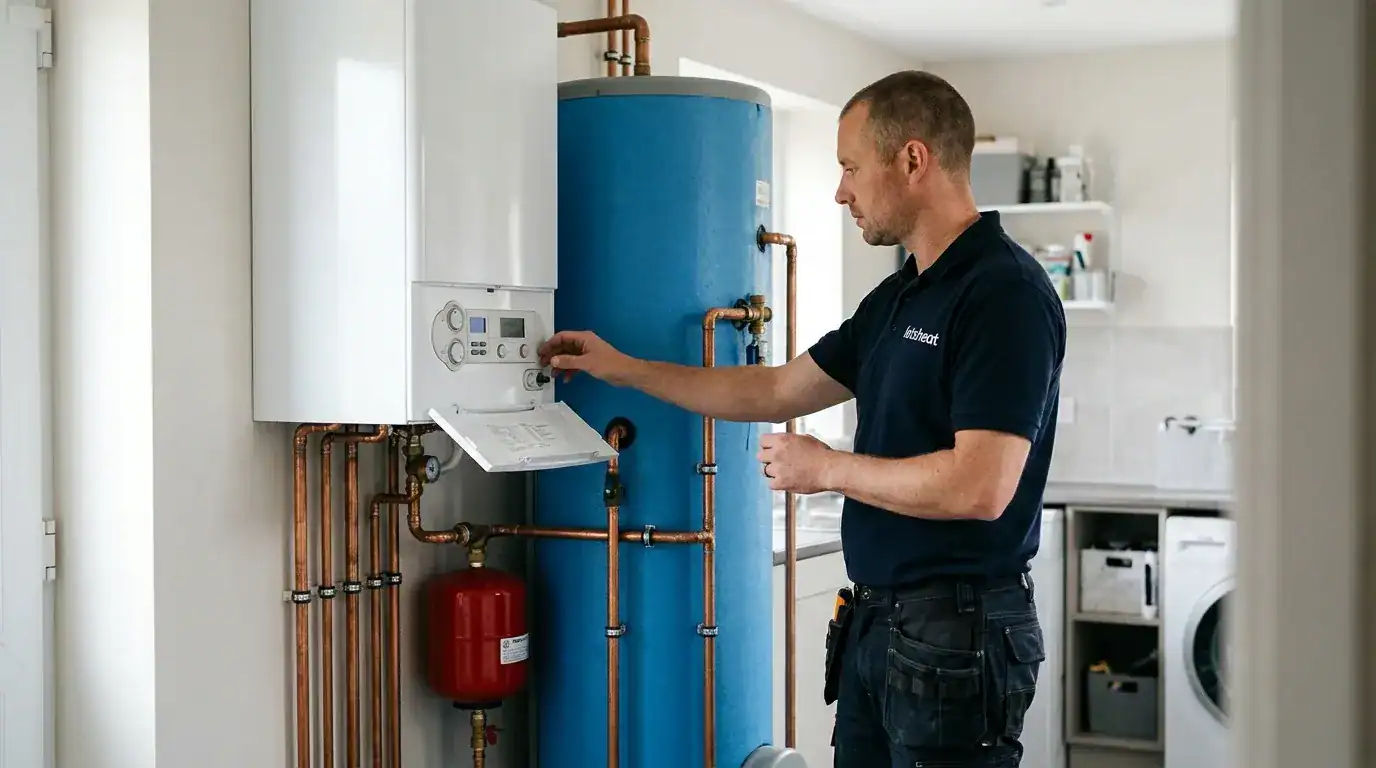
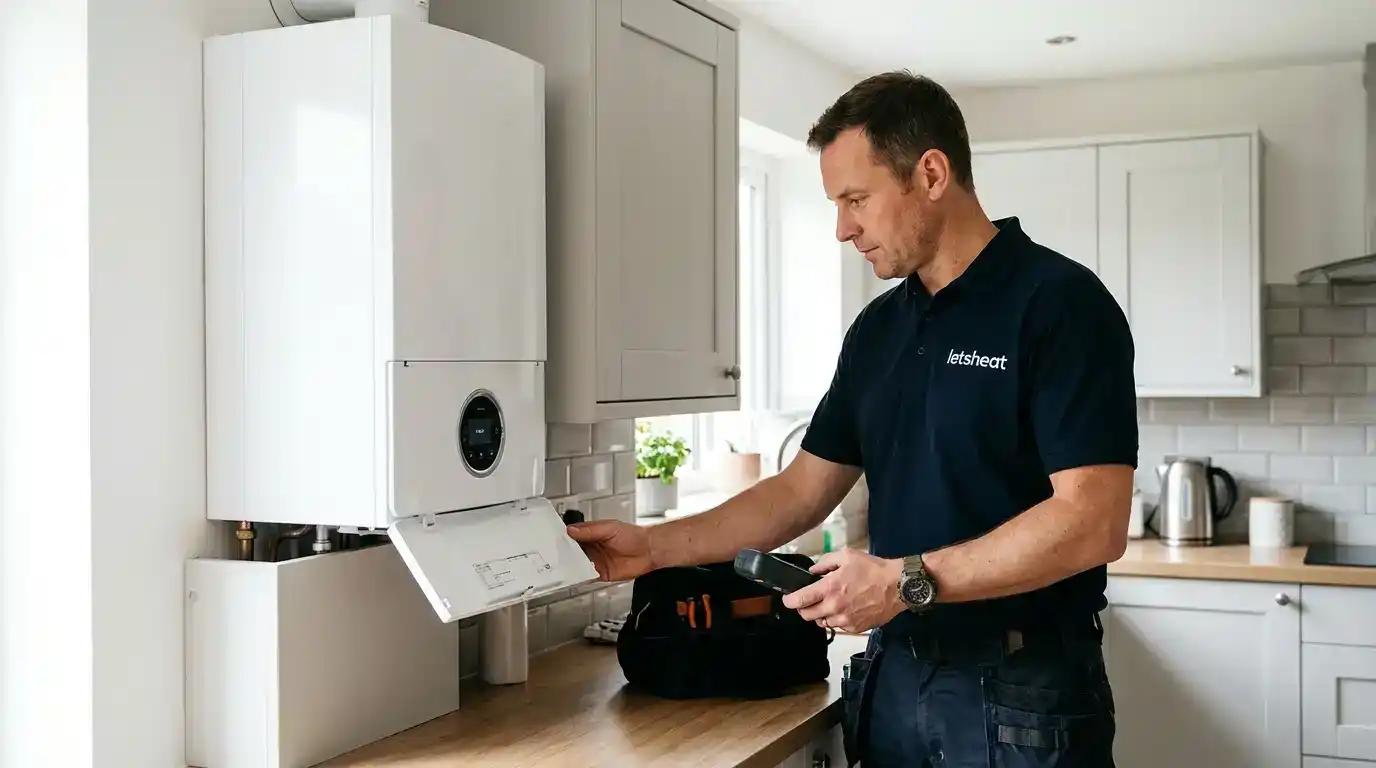
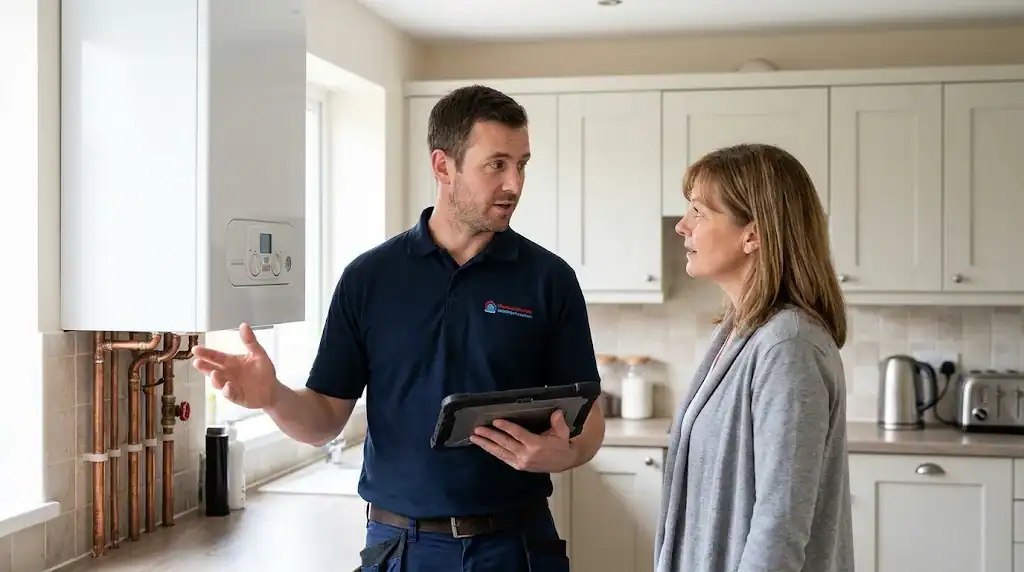
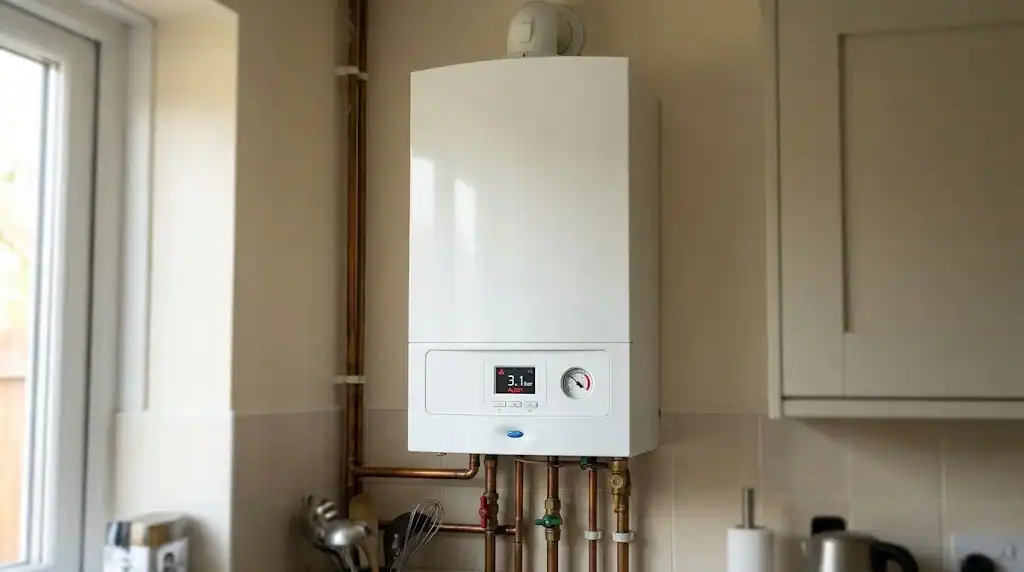
If your boiler has stopped working, is making unusual noises or has started needing frequent repairs, you may be asking: should I repair or replace my boiler?
Repair is often sensible when the fault is clearly identified, the boiler is otherwise in good condition, suitable parts are available and the repair cost is reasonable. Replacement becomes more worth comparing when the boiler is unreliable, deteriorating, difficult to support or facing a substantial repair.
There is no single age, fault code or repair price that automatically means you need a new boiler. The right decision depends on the actual fault, the boiler’s condition, repair history, parts availability, heating and hot-water requirements and the complete cost of both options.
If you are unsure, arrange a professional fault diagnosis before deciding. Let’s Heat’s boiler repair service can assess the fault and explain the available options before chargeable work proceeds. Safety first: Gas and combustion work must be carried out by a suitably qualified Gas Safe registered engineer. Do not remove the boiler casing or attempt to repair gas or internal safety components yourself.
Quick answer: should I repair or replace my boiler?
Start with the condition of the appliance rather than its age alone.
This is a guide, not a diagnosis. A boiler that is more than 10 years old may still be worth repairing if it is reliable and in reasonable condition. A newer boiler may still justify a replacement comparison if it has serious damage or a repair that is disproportionate to its condition.
How much does boiler repair cost?
Let’s Heat’s verified repair starting price is from £120, excluding VAT. This starting price includes the first hour of labour. It does not automatically include replacement parts, additional labour or a guaranteed full repair.
The final repair cost depends on:
•the component or parts required;
•the boiler make, model and age;
•additional labour after the first hour; and
•whether more than one fault is present.
Parts and additional work should be explained before proceeding. Do not treat from £120 as a fixed price for every boiler, a full-repair price or a guaranteed emergency call-out fee.
If the fault is likely to require repeated or expensive repairs, compare the repair estimate with the cost of a suitable replacement. You can read the new boiler cost guide before requesting a replacement quotation. 10 signs you may need to repair or replace your boiler
1. Your boiler breaks down frequently
One breakdown does not normally justify replacing a boiler. Repeated breakdowns are different.
If you have paid for several call-outs, components or recurring faults in a relatively short period, consider the total amount being spent rather than looking at each repair in isolation.
Repair may still make sense if several symptoms came from one underlying fault that has now been correctly diagnosed. Replacement becomes more worth comparing when different components continue to fail and confidence in the appliance is falling.
The engineer should first establish whether you have several independent faults or one unresolved issue causing repeated symptoms.
2. The repair quote is very high
The more expensive the confirmed repair becomes, the more useful it is to compare the cost with replacing the boiler.
An expensive repair is not automatically poor value. Consider:
•whether other major components show deterioration;
•the repair warranty; and
•the complete installed replacement cost.
If a substantial repair would leave you with an otherwise sound and dependable boiler, repair may still be worthwhile. If the same money is being spent on an older appliance with a history of faults, ask for a replacement comparison.
3. Your boiler is more than 10 to 15 years old
Boiler age matters, but it should not be used as an automatic replacement deadline.
A well-maintained older boiler with a straightforward repair may still provide useful service. As the boiler gets older, however, consider its breakdown frequency, parts availability, corrosion, efficiency, general condition and repair cost together.
If the appliance remains reliable and inexpensive to maintain, age alone is not a reason to remove it. See our guide to how long a boiler should last. 4. Your energy bills are increasing
Higher energy bills can make an older boiler’s efficiency worth reviewing, but the boiler should not automatically be blamed.
Energy use can also change because of energy prices, colder weather, household occupancy, heating hours, thermostat settings, controls, insulation and heat loss.
If an older boiler is already inefficient and now needs a substantial repair, replacement may become more attractive. If it is reliable and reasonably efficient, replacing it solely because your bill increased may not make financial sense.
A new boiler may reduce heating energy use where it replaces a less efficient system, but actual savings depend on the property, controls, household behaviour and existing appliance. Avoid guaranteed saving figures without a property assessment.
5. Replacement parts are difficult to find
Parts availability can materially affect whether repairing an older boiler remains sensible.
A fault may be technically repairable, but if the correct component is obsolete or increasingly difficult to source, maintaining the appliance can become less practical.
•Is the correct part still available?
•Is the component becoming obsolete?
•Are other major parts still supported?
•Would this repair leave the boiler reasonably supportable in the future?
Do not assume every old boiler has unavailable parts. Many older appliances remain serviceable when they are safe, maintained and supported.
6. Your boiler is leaking or showing corrosion
A leaking boiler does not automatically need replacing. The significance depends on where the water is coming from and what caused the leak.
A leaking seal, valve or connection can be very different from substantial corrosion or damage to an expensive major component.
•do not remove the boiler casing;
•do not attempt to seal internal components;
•protect nearby belongings where it is safe to do so; and
•arrange a diagnosis if the source is not obvious.
Repair may be appropriate for a contained, repairable leak. Replacement becomes more relevant when significant deterioration or a major-component failure is confirmed.
7. Your boiler makes banging, whistling or gurgling noises
Unusual boiler noises can have several causes and should not be used alone to decide that an appliance needs replacing.
Possible causes include air in the system, poor circulation, a pump problem, scale, sludge, pressure problems or another internal fault. Many noise-related problems can be repaired.
If unusual noises are one symptom among several recurring faults on an older boiler, they add weight to a replacement comparison.
8. Your boiler keeps losing pressure
A sealed heating system that repeatedly loses pressure should be investigated. Possible causes include a radiator or pipework leak, an internal boiler leak, a pressure-relief issue, an expansion-vessel problem or another heating-system fault.
Many pressure problems are repairable and do not require a new boiler. The important question is why the pressure is falling.
9. You have no heating or hot water
No heating or hot water can feel like a major boiler failure, but the cause may be relatively straightforward.
Possible faults include a controls problem, low system pressure, an ignition fault, a sensor, a diverter valve on a combi boiler, a pump, a circulation problem, a blocked condensate pipe or another component fault.
Do not replace a boiler simply because it stops working once. A professional fault diagnosis may identify a repairable problem. If the same appliance repeatedly loses heating or hot water despite previous repairs, replacement becomes more reasonable to compare.
10. Your boiler has a safety warning or carbon monoxide concern
Safety concerns must be treated differently from an ordinary repair-versus-replacement decision.
If you smell gas, suspect a gas escape, your carbon monoxide alarm activates or you believe the appliance may be unsafe, stop using it and follow the appropriate emergency guidance. In Great Britain, if you suspect a gas escape, call the National Gas Emergency Service on 0800 111 999. If there is an immediate danger to life or property, call 999 or 112.
Do not remove the casing or attempt to repair gas, combustion or internal safety components. A suitably qualified Gas Safe registered engineer should assess the appliance.
A safety issue does not automatically mean replacement is required. The first priority is making the situation safe and identifying the actual fault.
When is boiler repair usually the better option?
Repair is generally worth considering when the boiler is otherwise in reasonable condition and the fault is limited to a specific repairable problem.
•a thermostat or heating-control fault;
•a pressure-related issue;
•a blocked condensate pipe.
These are examples rather than diagnoses. Similar symptoms can have several causes, so the boiler should be tested before parts are ordered.
Repair becomes more attractive when parts are available, the appliance has been reliable and the repair provides a reasonable expectation of continued service. Let’s Heat repairs start from £120 excluding VAT, including the first hour of labour; parts and additional work may change the final cost.
When is boiler replacement usually the better option?
Replacement becomes more worth considering when several factors appear together, such as:
•difficult-to-source major parts;
•confirmed deterioration or corrosion;
•heavy spending on previous repairs; or
•a boiler that no longer suits the property’s heating or hot-water demand.
The strongest case for replacement is normally a combination of age, condition, reliability and repair economics rather than one isolated symptom.
Boiler repair cost versus boiler replacement cost
The cheapest option today is not always the cheapest option over the next several years.
What affects boiler repair cost?
A repair price can depend on the actual fault, required component, parts availability, diagnostic time, labour, boiler make and model, access and whether more than one fault is present.
A fault code alone is not always enough to quote accurately because the same code can have several possible causes.
What affects boiler replacement cost?
A fully installed replacement quotation can depend on:
•the new boiler type and output;
•property size and heat loss;
•whether the boiler stays in the same position;
•whether the boiler type changes;
•gas and heating pipework;
•removal of the old appliance; and
•any cylinder, tank, radiator or making-good work.
Questions to ask before choosing repair or replacement
•What exactly has failed?
•Has the same fault happened before?
•Are there other significant faults?
•Are the required parts available?
•What is the complete repair cost?
•Does the repair price include parts or only labour?
•What warranty is provided on the repair?
•What is the fully installed replacement cost?
•What exactly is included in the replacement quotation?
•Would the heating system need other changes?
•Is the engineer Gas Safe registered for the work involved?
A useful comparison looks at the likely outcome of repairing the current boiler against the complete cost, disruption and benefits of replacement.
Can regular servicing help avoid boiler replacement?
Regular servicing cannot prevent every component from eventually failing, but it can help identify developing problems and keep the boiler maintained.
A service also gives the engineer an opportunity to identify deterioration or maintenance issues before they become more serious. Let’s Heat’s boiler service takes approximately 40–60 minutes. Service starts from £75 when no replacement parts are required; the final price depends on the boiler type and age and whether parts are needed.
The £75 figure is not a fixed price for every boiler or visit and does not automatically include parts. See the boiler service page. How Let’s Heat can help
If you are unsure whether repairing or replacing your boiler makes more sense, the useful first step is normally identifying the actual fault.
Let’s Heat can help with:
•repair-versus-replacement assessments;
•replacement boiler options;
•Gas Safe registered gas work; and
•clear quotations before proceeding.
Boiler installation and replacement are available across Let’s Heat service areas, subject to complete postcode confirmation and survey requirements.
For local information, see the relevant page:
Use the city page that matches the property. Do not assume availability until the full postcode has been checked.
Frequently asked questions
Is it cheaper to repair or replace a boiler?
Repair normally has the lower immediate cost when the fault is straightforward. Repeated expensive repairs to an older, unreliable boiler can make replacement more attractive over time. Compare the confirmed repair cost, overall condition and complete replacement quotation before deciding.
Should I repair or replace my boiler after 10 years?
Not automatically. Age is one factor rather than a replacement deadline. A 10-year-old boiler that is reliable, maintained and inexpensive to repair may still be worth keeping. Age becomes more significant when combined with repeated breakdowns, poor parts availability or a substantial repair.
How often should a boiler be replaced?
There is no fixed replacement interval for every boiler. Condition, maintenance, usage, reliability, parts availability and repair history are more useful than an arbitrary age rule.
Is a leaking boiler worth repairing?
It can be. The answer depends on the source and severity of the leak. A repairable valve, seal or connection is different from substantial corrosion or failure of an expensive major component. Have the source diagnosed before deciding.
Can a new boiler reduce energy bills?
Replacing an inefficient older boiler may reduce heating energy use, but the actual result depends on the existing appliance, controls, property, insulation, household behaviour and energy prices. Avoid guaranteed saving figures without an assessment.
How do I know if a boiler repair is safe?
Gas work should be carried out by a suitably qualified Gas Safe registered engineer. Do not remove the casing or attempt to repair gas, combustion or internal safety components yourself.
Should I repair a boiler that keeps losing pressure?
First identify why the pressure is falling. Many causes are repairable. Replacement should be considered only if diagnosis reveals a serious problem or the pressure fault is part of wider deterioration and costly repairs.
Is it worth repairing an old boiler?
Sometimes. An older boiler that has been reliable, remains in reasonable condition and needs only a straightforward repair may still be worth fixing. Replacement becomes more attractive when age is combined with repeated breakdowns, difficult-to-source parts or a major repair.
Does boiler repair cost include parts?
Not automatically. Let’s Heat repair starts from £120 excluding VAT, including the first hour of labour. The actual fault, component and parts required can change the final price. Parts and additional work should be explained before proceeding.
Final answer: should I repair or replace my boiler?
Focus on the actual fault, boiler condition, reliability and total cost rather than age alone.
Repair is often sensible when the fault is clearly identified, parts are available and the rest of the boiler is in good condition. Replacement becomes more worth considering when an older appliance has become unreliable, expensive to maintain, difficult to source parts for or requires a substantial repair.
The safest decision follows a proper diagnosis rather than an assumption based on one symptom or fault code.
Safety and sources
Book a Boiler Repair →
Get a Boiler Replacement Quote →
Sources Checked
HSE – Domestic Gas Safety Guidance
Gas Safe Register
Energy Saving Trust – Boiler Guidance




 HSE domestic gas safety guidance and the Gas Safe Register. For general boiler guidance, see the Energy Saving Trust boiler guidance.