


Natural Gas vs LPG: A Cost and Efficiency Comparison
Boilers

Mo Alwadi
, Gas Safe Registered Engineer
Updated:
Updated:
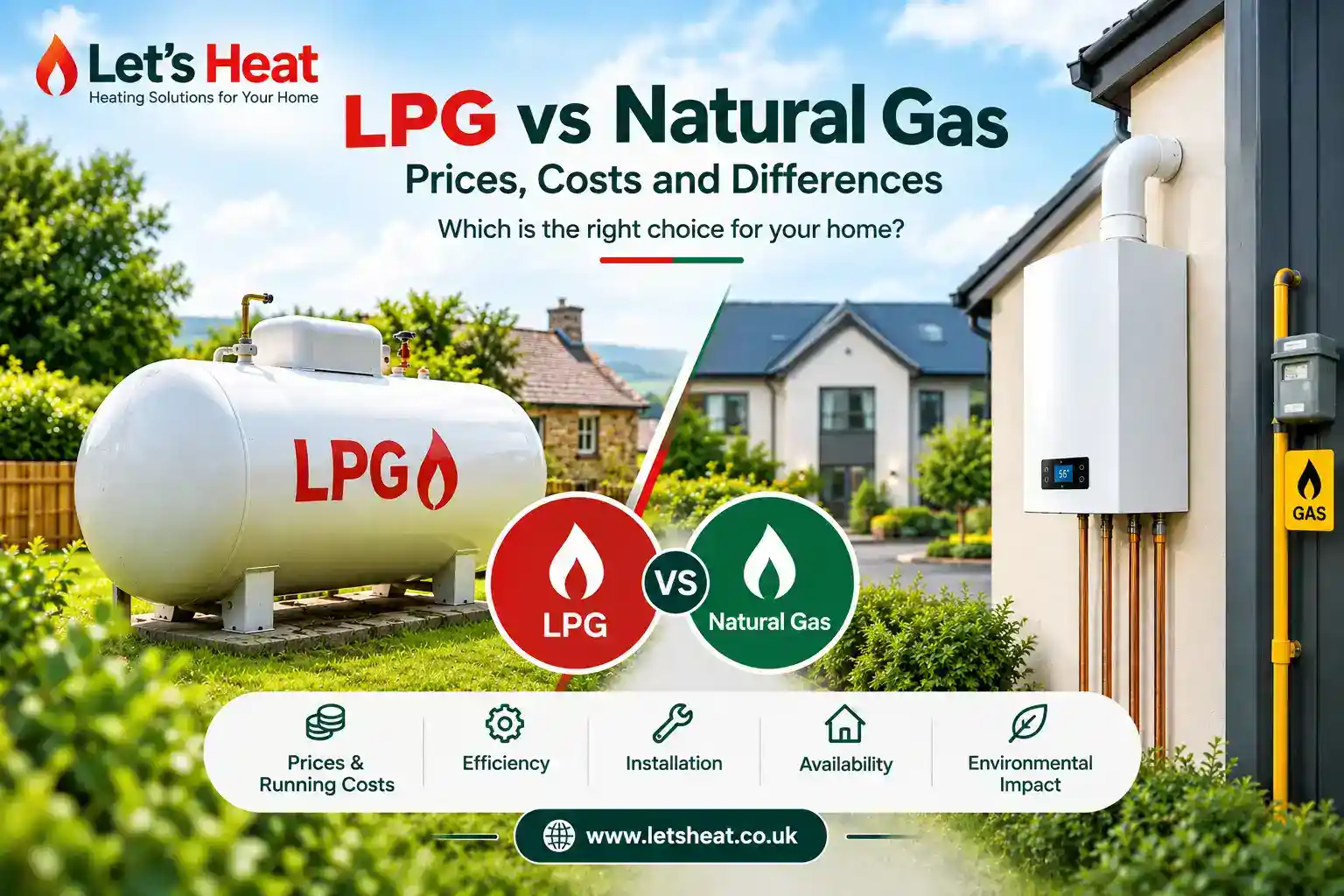
LPG vs natural gas is an important comparison for UK homeowners choosing between mains and off-grid heating. For most homes connected to the gas grid, natural gas is generally cheaper and more convenient than LPG, while LPG can be a practical alternative for properties without access to mains gas.
The cost of LPG vs natural gas depends on current fuel prices, boiler efficiency, your property, storage arrangements and how much energy your household uses.
In this guide, we compare LPG vs natural gas prices, running costs, efficiency, installation, availability and environmental considerations to help you understand which option may be better suited to your home.
| Comparison Factor | Mains Natural Gas | Bulk LPG (Propane) |
|---|---|---|
| Indicative UK Cost (Late 2026) | 7.97p/kWh (Ofgem price cap average)* | ~60p–75p/litre (approx. 9p–13p/kWh; varies by supplier & contract) |
| Price Cap Protection | Covered by Ofgem energy price cap | Not covered by Ofgem price cap |
| Supply Method | Piped directly via the mains gas grid | Delivered by tanker to an on-site tank (or 47kg cylinders) |
| Storage & Standing Fees | No tank needed; 29.68p/day standing charge* | On-site tank required; tank rental & delivery terms apply |
| Typical Running Costs | Generally lower | Generally higher than mains gas |
| Best Suited For | Homes connected to the mains gas grid | Off-grid and rural properties without mains gas |
The natural gas figure is the Ofgem average price-cap unit rate for Direct Debit customers in England, Scotland and Wales from October to December 2026. Actual tariffs vary.
In short: if your home already has access to mains gas, natural gas is usually the more economical and convenient option. LPG is particularly useful for properties that cannot connect to the gas grid.
LPG is generally not cheaper than mains natural gas for heating a UK home. If your property already has a gas-grid connection, natural gas will usually be the more economical option.
However, the actual amount you pay depends on current fuel prices, your gas tariff or LPG supply agreement, boiler efficiency and how much heating and hot water your household uses.
For off-grid homes, the comparison is different because mains natural gas may not be available. In that situation, LPG can be compared with other heating options such as oil, electricity and heat pumps.
When comparing LPG vs natural gas prices, it is important not to rely on an old fixed pence-per-kWh figure. Gas tariffs and LPG supplier prices change over time, so historic prices may not accurately reflect what a household will pay today.
Natural gas is supplied through the mains gas network and billed according to your tariff and usage. LPG is purchased from a supplier and stored at your property, with pricing affected by your supply agreement and delivery arrangements.
LPG may also involve additional costs associated with the storage tank and supply arrangement.
For this reason, compare current gas tariffs and LPG supplier quotes when calculating the likely running cost for your property rather than making a decision based on historic fuel prices.
As of October 2026, the Ofgem price cap average for mains gas is 7.97p per kWh for Direct Debit customers in England, Scotland and Wales. The daily gas standing charge is 29.68p. Actual prices vary by region, tariff and payment method.
For example, a home using 12,000 kWh of gas per year would pay around £956 for the gas used at 7.97p per kWh, before standing charges. This is an example calculation rather than an average household bill.
LPG prices vary considerably between suppliers and contracts. Domestic bulk LPG customers may pay different rates depending on their supplier, contract and delivery arrangements. For this reason, homeowners should check their current supplier quote when estimating LPG heating costs.
Both LPG and natural gas can be used to provide heating and hot water, but they differ significantly in how they are supplied and stored.
LPG stands for liquefied petroleum gas. In the UK, domestic bulk LPG used for home central heating is predominantly propane, stored under pressure as a liquid in an outdoor above-ground or underground tank and topped up by tanker deliveries. Smaller bottled gas (47kg propane cylinders) is also used by some off-grid homes, though it typically costs more per kWh than bulk tank LPG.
Mains natural gas (sometimes called piped gas) is mostly methane supplied directly to your property through the national gas network—so you never need a storage tank or fuel deliveries.
Natural gas used for domestic heating is supplied directly to properties through the mains gas network.
Unlike LPG, households connected to the gas grid do not normally need to store their heating fuel on-site or arrange regular fuel deliveries.
For homes already connected to the gas network, this generally makes natural gas a convenient option for central heating and hot water.
The cost of installing an LPG or natural gas boiler depends on much more than the fuel type.
Factors that can affect the installation price include:
An LPG heating system also requires suitable fuel storage arrangements at the property.
If your existing boiler needs replacing, it is worth comparing new boiler options and the overall cost of the heating system rather than looking only at the purchase price of the boiler.
The different energy content of LPG and natural gas does not automatically mean that an LPG boiler is more efficient.
Boiler efficiency describes how effectively the appliance converts the energy in its fuel into useful heat. This depends on factors such as the boiler design, age, condition, controls and installation.
Modern condensing boilers improve efficiency by recovering heat from exhaust gases that would otherwise be lost through the flue. The Energy Saving Trust provides further guidance on boiler types, efficiency and choosing a heating system.
Regular boiler servicing can also help ensure your boiler is checked and properly maintained.
Therefore, when comparing LPG and natural gas, consider the efficiency of the specific boiler alongside the price of the fuel rather than assuming one fuel automatically produces a more efficient heating system.
In most UK homes, LPG—including bottled gas—is still cheaper per kWh than standard-rate mains electricity, though more expensive than mains natural gas. Under the October–December 2026 Ofgem price cap, standard Direct Debit electricity averages 26.32p/kWh, compared with around 9p–13p/kWh for bulk LPG and roughly 14p–18p/kWh for 47kg propane bottles (before tank rental or cylinder delivery charges).
However, electricity powers air source heat pumps, which operate at much higher efficiencies than combustion boilers—meaning a well-sized heat pump can often deliver lower annual heating costs than bottled or bulk LPG in an off-grid property.
Both LPG and natural gas are fossil fuels, so both produce greenhouse gas emissions when burned.
A meaningful environmental comparison should consider factors such as the type and amount of fuel consumed, boiler efficiency and relevant supply-chain emissions rather than assuming that one fuel is automatically the more environmentally friendly option.
The UK Government publishes updated greenhouse gas conversion factors that can be used when calculating emissions associated with different fuels.
If reducing your home’s reliance on fossil-fuel heating is a priority, you may also want to investigate lower-carbon heating alternatives such as a heat pump, depending on the property and its heating requirements.
If your home is off the mains gas grid, several leading UK boiler manufacturers offer dedicated LPG models or official LPG conversion kits. Because LPG installations require specific gas-train settings, flue checks and a Gas Safe engineer qualified for LPG work, installation pricing is provided on a quotation-required basis following a property assessment.
Starting prices shown for standard natural gas installations are subject to the property, boiler selected and work required. Manufacturer warranties vary by boiler and package, with up to 12 years available on selected boilers.
An LPG boiler may be worth considering if your property does not have access to mains gas and you want a boiler-based central heating system.
LPG may be suitable if:
If mains natural gas is already available at the property, natural gas will generally be the more economical and convenient of the two options.
Natural gas is generally the more economical and convenient option for a UK home that already has access to the mains gas grid. LPG is primarily an alternative for properties where mains gas is unavailable.
Consider natural gas if your home already has a gas connection and you want a continuous fuel supply without having to store and order fuel.
Consider LPG if your property is off-grid, you have suitable space for fuel storage and a boiler-based central heating system suits your property.
If you are planning to replace your current heating system, our boiler installation guide explains more about choosing and installing a new boiler.
Before making a decision, compare current fuel prices, installation costs, expected running costs, boiler efficiency and other suitable heating technologies for your home.
Whether you are upgrading an existing mains gas boiler or comparing options for an off-grid property, the Gas Safe registered team at Let’s Heat (Registration No. 977042) can advise on suitable boiler models and provide a clear, tailored quote. We cover Cardiff, Newport, Barry, Penarth, Bristol and selected surrounding areas (subject to postcode and availability)—call 0330 174 6700 or request a new boiler quote online.
LPG is generally more expensive to run than mains natural gas in the UK. Actual household costs depend on current fuel prices, your tariff or supply agreement, boiler efficiency and how much energy your home uses.
No. LPG and natural gas are different fuels. LPG consists mainly of propane and butane and is stored as a liquid under pressure, while natural gas for grid-connected homes is supplied through the mains gas network.
A domestic LPG central heating system normally requires fuel to be stored in a suitable tank at the property, which is replenished through fuel deliveries.
Yes. LPG is one of the heating options available to properties that do not have access to the mains gas network.
Modern LPG boilers can use condensing technology. However, the efficiency of an individual boiler depends on its specification, age, condition, controls and installation rather than simply whether the fuel is LPG or natural gas.
Gas and LPG boiler work should be carried out by an appropriately qualified Gas Safe registered engineer. Always check that the engineer is qualified for the specific type of gas work required.
LPG heating is generally more expensive to run than mains natural gas, but the actual cost depends on the LPG supplier, contract, fuel price, boiler efficiency and household energy use. For an accurate comparison, compare your current LPG supplier quote with the latest gas tariff available for your property.
Mo Alwadi is Renewable Manager at Let’s Heat and a Gas Safe registered engineer (registration no. 977042), with experience in domestic heating and air conditioning. He contributes technical guidance on boiler installation, boiler replacement, heating systems, air conditioning and home energy solutions, helping UK homeowners understand their options and make informed decisions.
View all posts by Mo Alwadi →